
- EA, Executive Support
- No Comments
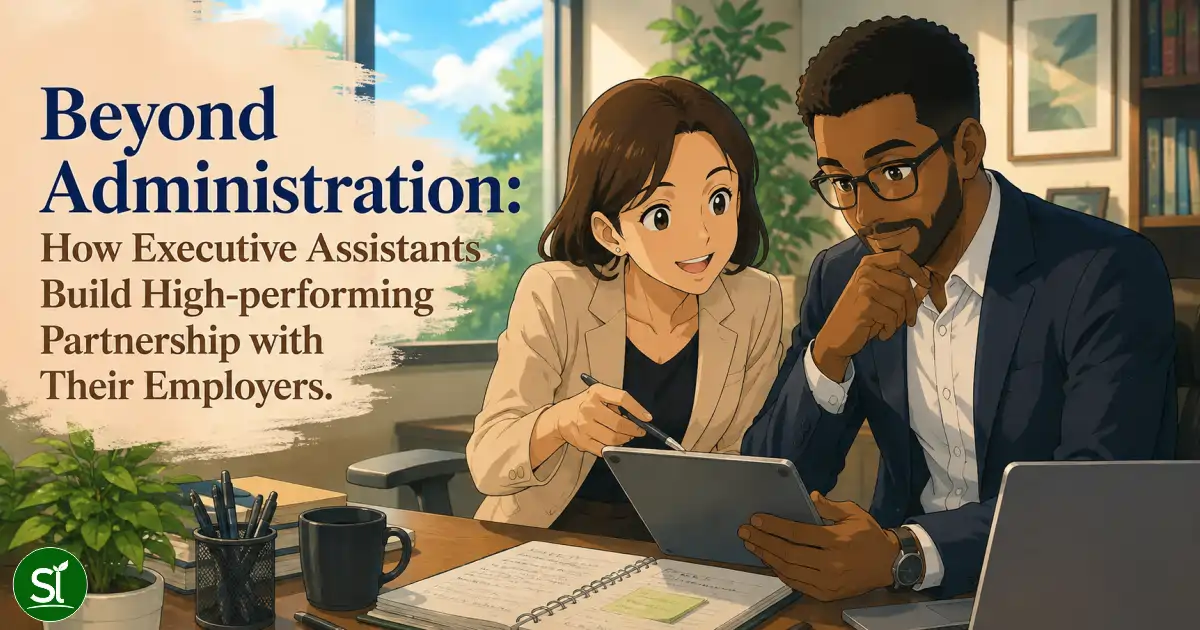
The relationship between an Executive Assistant and their employer is one of the most important partnerships in any organisation, and the quality of this relationship often determines how successful both parties become.
Beyond Administration: How Executive Assistants Build High-performing Partnership with Their Employers
Many people think the job of an Executive Assistant is simply scheduling meetings, booking travel, and managing emails.
An Executive Assistant (EA) is more than someone who manages schedules and answers emails.
In reality, the best Executive Assistants do something far more valuable.
They become trusted strategic partners.
A great Executive Assistant becomes a trusted partner who helps the employer stay organized, focused, and productive.
The relationship between an Executive Assistant and their employer is one of the most important partnerships in any organisation, and the quality of this relationship often determines how successful both parties become.
Building a strong working relationship requires professionalism, trust, communication, and a commitment to shared goals.
A relationship built on trust, communication, and mutual respect enables leaders to focus on high-impact decisions while ensuring the business runs smoothly behind the scenes.
If you want to become an Executive Assistant that every executive values, here are some key principles worth mastering.
Understand Your Employer's Goals, Visions, and Priorities
Your role as an EA isn’t just to support your employer’s daily activities, it is to support their mission.
Your employer’s priorities should become your priorities, his/her goals and visions also automatically become yours.
Take time to carefully understand their vision, objectives, work style, short-term/long-term goals, etc.
When you know what success looks like for your employer, you can anticipate needs instead of simply reacting to requests.
Take time to understand:
- Their business objectives.
- Their personal working style.
- Their biggest challenges.
- Their short-term/long-term goals.
- What success looks like to them.
You may need to ask yourself:
- What are their biggest priorities this quarter?
- What tasks consume most of their time?
- How can I make their work easier?
The more you understand where they’re going, the better you can help them get there.
Learn Their Preferred Working Style
No two executives work the same way – every executive is different.
Some prefer detailed reports, while others want brief summaries. Some make decisions quickly, while others need supporting information before acting.
Some are proactive, while some are reactive. Some rely heavily on emails, while others prefer instant messaging or phone calls.
Carefully observe:
- Their preferred communication method.
- Their meeting habits.
- Their decision-making style and processes.
- Their daily routines.
- Their preferred level of detail.
Adapting to their preferred working style makes you an EA who better understands his/her employer – one of the quickest ways to become indispensable.
Adapting to your employer’s style is one of the quickest ways to become indispensable.
Build Trust Through Consistency
Trust isn’t built by grand gestures, no. It’s built or earned every day through consistency.
Deliver what you promise.Complete assignments on time, and follow through without being reminded.
Meet deadlines. Keep promises. Maintain confidentiality. And never forget to admit mistakes honestly when they happen.
Your employer should have complete confidence that when something has been delegated to you, it will be completed professionally. Your employer should never have to wonder whether an important task has been completed or not – BE RELIABLE.
Reliability builds confidence, and confidence leads to greater responsibility.
Communicate Clearly and Professionally Before You're Asked
Communication is one of the most valuable skills an Executive Assistant can possess.
Exceptional Executive Assistants don’t wait for updates to be requested, they communicate proactively.
So, communicate proactively and keep your employer informed without overwhelming him/her.
Let your communication be concise, factual, and solution-oriented.
Provide:
- Daily or weekly updates.
- Meeting reminders.
- Status reports.
- Important deadlines.
- Potential risks.
Also, keep your employer informed by providing:
- Progress updates.
- Upcoming deadlines.
- Potential risks.
- Meeting reminders.
- Action items requiring attention.
Good communication reduces surprises – and C-class executives appreciate fewer surprises.
Be Proactive Rather Than Reactive
The difference between a good Executive Assistant and an exceptional one often comes down to anticipation.
First, don’t wait to be told everything. Next, anticipate problems before they occur. As an exceptional EA, your goal is to stay one step ahead.
A proactive Executive Assistant, don’t simply respond to problems, prevent them.
- Confirms meetings before they happen.
- Prepares briefing documents in advance – before meetings.
- Confirms appointments in advance.
- Follow up on delegated tasks.
- Identify bottlenecks before they become urgent.
- Suggests better ways of working.
When you’re constantly thinking two or three steps ahead, you become a genuine strategic asset.
Protect Your Employer's Time
Time is an executive’s most valuable resource.
Every unnecessary meeting, interruption, or poorly planned schedule comes at a cost.
Help your employer protect time by:
- Prioritising important works and requests.
- Screening unnecessary meetings and commitments.
- Creating realistic schedules and avoiding scheduling conflicts.
- Allowing preparation and travel time.
- Reducing avoidable interruptions.
- Grouping similar tasks together.
- Ensuring meetings have clear agendas.
Managing time well isn’t about filling every available slot, it’s about protecting the time needed for meaningful work.
Master Calendar and Email Management
Effective calendar management goes beyond booking appointments, and managing a calendar is more than accepting meeting invitations.
- Does your employer have enough preparation time?
- Are meetings scheduled back-to-back?
- Is there time allocated for focused work?
Think strategically and ensure there is adequate travel time, preparation time, breaks, and buffer periods between meetings.
Likewise, effective email management means helping your employer focus on what truly matters by prioritising emails/messages, drafting responses where appropriate, and keeping communication organised.
- Keep the inbox organised.
- Prioritise urgent messages.
- Flag items requiring immediate attention.
- Draft responses where appropriate.
- Archive completed conversations.
You need to keep an eye on my next post on the email triage system.
Likewise, effective email management means helping your employer focus on what truly matters by prioritising messages, drafting responses where appropriate, and keeping communication organised.
Handle Confidential Information Professionally and with Integrity
Executive Assistants often have access to highly sensitive business and personal information. Confidentiality and integrity are not optional, they are part of the foundations of trust.
Never discuss confidential matters unnecessarily. Maintain discretion at all times.
Discretion earns respect, and respect creates long-term professional relationships.
Also, always remember that once trust is broken, it is difficult to rebuild.
Become an Excellent Problem Solver
Bring solutions, not just problems. Executives appreciate EAs who think critically, assistants who present solutions instead of just identifying problems.
So, instead of saying:
“We have a scheduling conflict.“
Say:
“We have a scheduling conflict. I’ve identified three possible alternatives.“
Thinking ahead and problem-solving demonstrates leadership, initiative, and ownership.
Maintain Professional Boundaries
Avoid the temptation of getting too familiar with your Executive. A positive working relationship doesn’t require becoming overly familiar with your employer.
Professionalism, emotional intelligence, and mutual respect create healthier and more productive partnerships than blurred boundaries ever will.
So, develop a positive working relationship while maintaining professionalism. Respect boundaries, remain objective, and avoid office gossip or unnecessary workplace politics.
Don’t forget, professionalism strengthens credibility.
Never Stop Learning
The Executive Assistant profession is evolving rapidly.
Today’s top Executive Assistants are developing skills in:
- AI-powered productivity tools.
- Microsoft Office and Google Workspace.
- Project management.
- Data analysis.
- Business communication.
- Leadership skills and support.
- Process improvement.
- Event planning.
- Time management.
- Digital collaboration.
Stay current by improving your knowledge. Continuous learning not only keeps you relevant, it also increases your value.
Represent Your Employer with Excellence
As an EA, you are the first point of contact in many situations,
Whether answering calls, welcoming visitors, or responding to emails, your professionalism reflects directly on your employer.
Be courteous, organised, and solution-focused.
Whether you’re answering calls, responding to emails, welcoming visitors, coordinating meetings, or speaking with stakeholders, you are often seen as an extension of your employer, and your professionalism reflects directly on your employer.
So, be courteous, organised, and solution-focused. Represent your executive with confidence, courtesy, and excellence.
Always let your professionalism shape first impressions.
Final Thoughts
Working successfully with your employer goes far beyond completing administrative tasks. It is about building a partnership founded on trust, communication, reliability, and strategic support.
The most respected Executive Assistants are those who understand their employer’s vision, anticipate needs, solve problems proactively, manage priorities, reduce friction, anticipate needs, solve problems before they escalate, and consistently make their executive’s life easier.
Most importantly, they become trusted partners who make their employer more productive, more organised, and more effective.
When you become a dependable partner rather than just a support staff member, you elevate both your career and the success of the organisation.
What do you think is the most important quality an Executive Assistant should develop to build a strong working relationship with their employer?
I’d love to hear your thoughts in the comments.
READ MORE: Executive Assistant Tips and Tricks
Login
0 Comments
Newest
Oldest
Most Voted
Share:
More Posts

Table of Contents
Add a header to begin generating the table of contents