

- No Comments
- EA, EA Fundamentals
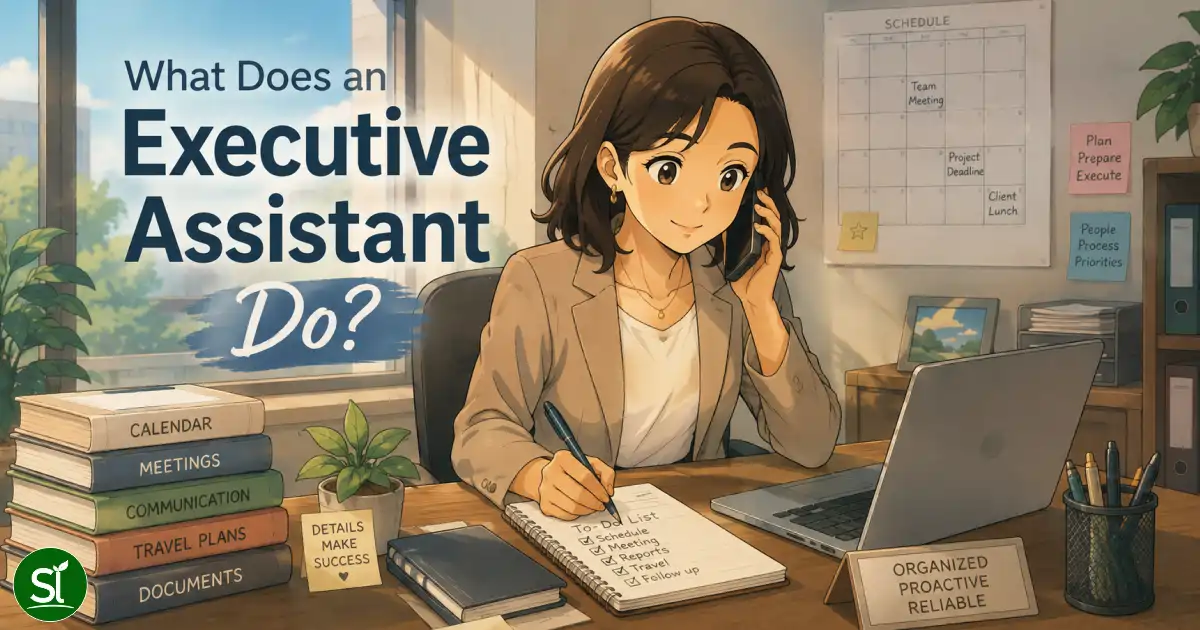
New Executive Assistants often confuse their role with general office administration, but an EA operates closely with leadership to drive business efficiency.
What Does an Executive Assistant Do?
An Executive Assistant (EA) is far more than someone who just manages calendars or answers calls/emails.
In today’s fast-paced business environment and demanding corporate landscape, Executive Assistants serve as strategic partners to business leaders, helping them stay organized, make informed decisions, and focus on high-impact priorities.
Modern leaders rely on EAs to act as their second brain. When a highly skilled EA performs their job well, they serve as a force multiplier for the entire organization.
They act as the bridge between executives, teams, clients, and stakeholders, ensuring that communication flows smoothly and daily operations run efficiently.
As organizations become more complex, the role of an Executive Assistant continues to evolve beyond traditional administrative duties.
Modern EAs are trusted professionals who combine exceptional organizational skills, problem-solving abilities, discretion, and business acumen to support executives in achieving both personal and organizational goals.
In this article, we’ll explore what an Executive Assistant does, the key responsibilities they handle, which make them indispensable to successful leaders and businesses.
Administrative Tasks:
Schedule and manage appointments
An executive assistant is typically responsible for managing the calendar of the executive they work for.
This involves scheduling appointments, coordinating with other members of the team to ensure that everyone is aware of the executive’s schedule, and rescheduling appointments if necessary.
Executive assistants must be organized and able to manage competing priorities to ensure that the executive’s schedule runs smoothly.
Manage phone calls and correspondence
Another important administrative task for an executive assistant is managing the executive’s phone calls and correspondence.
This includes answering phone calls, screening calls and emails, and directing calls to the appropriate person or department.
They are also responsible for composing and sending correspondence on behalf of the executive, such as emails, memos, and letters.
Organize and maintain files
Executive assistants are often responsible for organizing and maintaining paper and electronic files.
This includes managing sensitive and confidential information, such as financial records, legal documents, and personal information.
When the information is extra sensitive, such as Executive Assistant roles in the legal industry, then you’ll likely be paid more as a result of the extra trust and care required.
Executive assistants must be detail-oriented and able to keep track of multiple files and documents.
Handle travel arrangements
Travel arrangements are another common responsibility of executive assistants.
This can include booking flights, hotels, rental cars, and other travel arrangements for the executive.
Executive assistants must be able to navigate complex travel itineraries and manage last-minute changes to ensure that the executive’s travel plans run smoothly.
According to TravelPerk, here are 8 key steps to successfully make travel arrangements for your boss:
- Communicate to create a successful experience
- Find a travel management tool to arrange travel and accommodation
- Have a point person for itinerary changes in the eleventh hour
- Help prepare your executive’s cell phone
- Always keep track of preferences
- Simplify expense reporting
- Prepare an in-depth travel itinerary for your boss
- Take care of the “little extras”
For a more in-depth discussion on this topic look out for my article on Executive Assistant Travel Checklist.
Manage office operations
In addition to supporting the executive, executive assistants are often responsible for managing office operations.
This can include ordering office supplies, managing equipment and facilities, and ensuring that the office runs smoothly.
Executive assistants must be able to manage multiple tasks simultaneously and have strong organizational and communication skills.
Support Tasks:
Assist with projects
Executive assistants often assist with projects on behalf of the executive, which can include researching, coordinating, and executing projects.
This can include preparing presentations, creating reports, and organizing events.
Executive assistants must be able to manage multiple projects simultaneously and work well under pressure.
Liaison with other departments
Executive assistants are often the primary point of contact for other departments and stakeholders on behalf of the executive.
This can include communicating with team members, clients, and vendors.
Executive assistants must have strong communication and interpersonal skills and be able to build positive working relationships.
Support team coordination
Executive assistants often play a key role in coordinating meetings, events, and other activities with other members of the team.
This can involve scheduling meetings, setting agendas, and preparing materials for meetings.
Executive assistants must be able to work collaboratively with others and have strong communication and organization skills.
Conduct research and analysis
Executive assistants often conduct research and gather data to support the executive’s decision-making.
This can include analyzing market trends, researching industry best practices, and reviewing financial data.
Executive assistants must have strong analytical and research skills and be able to present information clearly and concisely.
Gatekeep access to the executive to protect their time.
Gatekeeping is the process of filtering access to an executive to protect their time, focus, and energy. It is not about blocking people out, but about ensuring the leader only spends time on tasks that truly require their attention.
Key Mechanisms of Gatekeeping
- Inbox Triage: Reviewing incoming emails, archiving spam, flagging urgent issues, and drafting responses to routine questions.
- Calendar Shielding: Declining low-priority meetings, scheduling necessary “deep work” blocks, and ensuring buffer time between appointments.
- Visitor Management: Vetting internal and external requests for meetings before they ever reach the executive’s radar.
- Information Filtering: Summarizing long reports or lengthy email threads into concise, actionable bullet points for quick decision-making.
Strategic vs. Reactive Gatekeeping
- Reactive: Saying “no” to people simply because the calendar looks full.
- Strategic: Knowing the executive’s top 3 business priorities and actively prioritizing requests that align with those specific goals.
The Art of the “Soft No”
Effective gatekeepers protect time without damaging professional relationships. They do this by offering alternatives:
- Redirection: “The executive cannot make this meeting, but [Name] from the marketing team is the best person to handle this.”
- Delegation: “Please send over a brief summary of your proposal, and I will ensure it is reviewed during our weekly alignment.”
- Delaying: “We are fully booked this month due to board preparation, but let’s revisit this during the first week of next month.”
Manage confidential information
Executive assistants often have access to sensitive and confidential information, including financial records, legal documents, and personal information.
As such, executive assistants must be able to manage confidential information with discretion and professionalism.
Since this is such an important part of an Executive Assistants role, some quick tips are:
- Always lock your laptop when you leave your desk or phone.
- Consider using a tool such as LastPass to manage all your passwords. If your passwords are leaked, then the private information of both yourself and the executive you work for, becomes accessible.
- Always securely dispose of printed documents when they are no longer needed. This helps prevent not only others from seeing sensitive information about the business but also prevents people from being able to use these documents for identity theft.
Communication Tasks:
Executive assistants are often responsible for coordinating communication between the executive and other members of the team, clients, and stakeholders.
This can include managing the executive’s email inbox, coordinating phone calls and video conferences, and scheduling meetings.
Executive assistants must have strong communication and organizational skills to ensure that communication runs smoothly.
Represent the executive
Executive assistants may be responsible for representing the executive in meetings, events, and other activities.
This can include attending meetings on behalf of the executive, preparing presentations, and delivering speeches.
Executive assistants must be able to communicate effectively and professionally, representing the executive and the organization positively.
Manage social media accounts
Executive assistants may be responsible for managing the executive’s social media accounts, including drafting and posting content and responding to messages and comments.
Executive assistants must be able to communicate in the organization’s voice and tone and respond appropriately to followers.
Coordinate communication with media
Executive assistants may also be responsible for coordinating communication with the media on behalf of the executive or the organization.
In smaller companies, this means preparing press releases, coordinating interviews, and responding to media inquiries, but in larger companies, there will likely be a PR agency or an internal team that manages the media and everything related to it.
Manage crisis communication
In the event of a crisis, such as a natural disaster, security breach, or other emergency, executive assistants may be responsible for managing communication with stakeholders, including employees, clients, and the media.
This can include preparing statements, coordinating responses, and managing communication channels. However, as mentioned above, in larger companies there will be an entire department that manages communications on behalf of the organization.
Summary
Overall, executive assistants play a crucial role in supporting the executive they work for and ensuring that the organization runs smoothly.
They must be able to manage a wide range of tasks, from administrative tasks such as scheduling and managing appointments to communication tasks such as representing the executive and managing crisis communication.
Strong communication, organization, and interpersonal skills are just some of the essential skills for success as an executive assistant.
(watch out for my next article on What Skills Does an Executive Assistant Need?)
To learn more about being an exceptional and productive EA and to access useful resources, subscribe to our newsletter. If you have any questions, reach out via the comment box. We love to hear from you!
Login
0 Comments
Newest
Oldest
Most Voted
Share:
More Posts

Table of Contents
Add a header to begin generating the table of contents